 Keeptly
Guide · Receipts
How to read sales tax on a receipt, and when it matters
The tax line on a receipt is easy to skip, but it is worth a glance. It shows what you actually paid in tax, lets you check the rate, and in some cases supports a deduction at tax time.
Where to find it
- Item lines: each product and its price. Some receipts mark taxable items with a letter such as T.
- Subtotal: the total before tax.
- Tax: one line, or several if state and local taxes are shown separately.
- Total: what you paid.
- Payment: card or cash, often with the last four digits of the card.
- Receipt or transaction number: useful if you return the item or need a copy.
Work out the rate
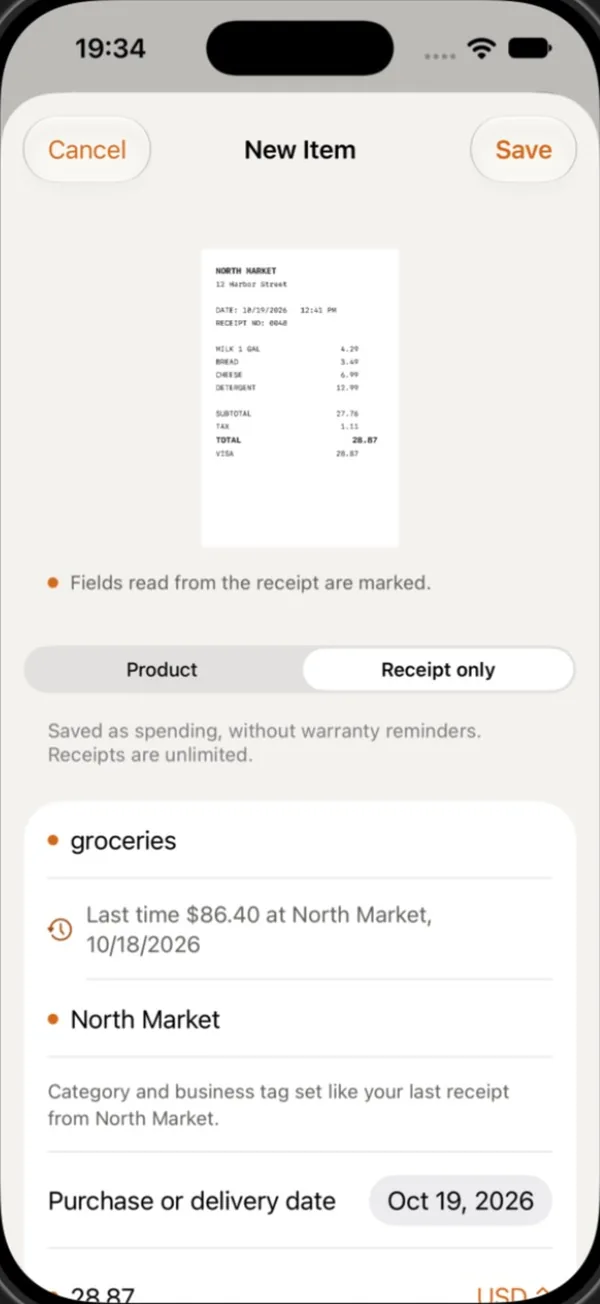
Divide the tax by the taxable subtotal. On a sample grocery receipt with a subtotal of $27.76 and tax of $1.11, the rate is 1.11 ÷ 27.76, or about 4.0%.
If some items on the receipt are not taxed, the rate applies only to the taxable part, so the result can look lower than the rate posted at the register. In that case, add up only the items marked as taxable before you divide.
Example: a cordless vacuum costs $649.00 and the tax line says $51.92. The rate is 51.92 ÷ 649.00 = 8.0%. If the total is $700.92, the numbers add up.
When the tax line matters
The sales tax deduction
According to the IRS, if you itemize deductions you can elect to deduct state and local general sales taxes instead of state and local income taxes. You can use your actual expenses or the optional sales tax tables in the Schedule A instructions, and the IRS also offers a sales tax deduction calculator. If you use actual expenses, your receipts are the record that supports the number.
There is a cap on the combined state and local tax deduction. The IRS page currently lists $40,000, or $20,000 if married filing separately, reduced at higher incomes. Check the Schedule A instructions for your own tax year, or ask a tax professional.
Business expenses
For business purchases, the IRS expects records that show who you paid, how much, when and for what. A receipt with a readable tax line is part of that record. Our guide on organizing receipts for your accountant covers the details.
Returns and price checks
When you return something, the tax line helps you check that the refund matches what you paid. It is also an easy way to spot a mistake at the register, such as an item taxed twice.
Which receipts to keep
- Large purchases. A car, furniture or an appliance carries a large tax amount. If you deduct actual sales taxes, these receipts matter most.
- Anything for your business. Keep the full receipt, not only the card statement line.
- Online orders. The order confirmation email usually shows the tax as its own line. Save it with the receipt.
- Anything you might return. The receipt shows the tax you should get back.
If a receipt is printed on thermal paper, take a photo the day you get it. Our guide on why receipts fade explains how quickly the print can disappear.
How Keeptly helps
- Keeptly reads the store, date, total and tax lines when they are printed, right on your iPhone. You can check and edit every field.
- Insights shows your spending for the month, and with Premium, the tax total as printed on your receipts.
- The accountant package includes the tax lines for every receipt in its Excel workbook.
Questions
Is sales tax included in the shelf price?
In most U.S. stores, no. It is added at checkout and shown as a separate line on the receipt.
Can I deduct the sales tax I pay?
If you itemize, the IRS lets you elect to deduct state and local general sales taxes instead of income taxes, within the limits it sets.
Do I need every receipt for the sales tax deduction?
Not necessarily. The IRS lets you use its optional sales tax tables instead of your actual expenses.
Sources
- Topic no. 503, Deductible taxes · Internal Revenue Service
- What kind of records should I keep · Internal Revenue Service