 Keeptly
Guide · Business receipts
How to organize receipts for your accountant
Most accountants do not mind how many receipts you have. They mind receipts that are faded, missing a date or mixed in with personal shopping. A short monthly routine fixes most of that.
What a business receipt should show
The IRS lists the supporting documents for business expenses: canceled checks or other proof of payment, cash register receipts, account statements, credit card receipts and statements, and invoices. Whatever form it takes, the record should show who you paid, the amount, proof of payment and the date. It should also describe the item or service well enough to make clear that the cost was for the business.
One document is not always enough. The IRS notes that a combination of documents may be needed. A card statement proves that you paid a store; the receipt shows what you bought.
Paper or digital?
You do not need a drawer full of paper. The IRS says you may keep records in an electronic system, as long as it follows the same basic recordkeeping principles: all requirements that apply to paper records also apply to electronic ones. A clear photo with a readable date, total and seller is far more useful than an original that has faded. For how long to keep everything, see our guide on how long to keep receipts.
A monthly routine
- Capture on the same day.
Photograph or scan the receipt before it goes into a pocket. Thermal paper fades quickly; our guide on why receipts fade explains why.
- Mark it business or personal.
Decide at the moment you buy, while you still remember what it was for.
- Add the purpose.
For meals, travel or anything that could look personal, add a short note: who it was with, which project, why.
- Check the details.
Make sure the date, total and tax can be read. Retake any photo that cut off an edge.
- Send one package.
At the start of each month, send last month's records together: a spreadsheet with a row for every receipt, a short summary, and the receipt images numbered to match the rows.
Mistakes that cost time
- Faded or crumpled receipts that nobody can read.
- Personal shopping mixed in, so every line needs a question.
- A card statement line with no receipt behind it.
- Photos named "IMG_4021" with nothing to say which row they belong to.
Example: a freelance designer has 23 receipts in October: software, a client lunch, train tickets and a monitor. Marking each one as business on the day and adding "client: brand workshop" to the lunch gives the accountant a list they can use without a single follow-up email.
Which costs are deductible, and how, is a question for your accountant. Your job is to give them complete, readable records.
How Keeptly helps
- You mark a receipt as a business expense when you save it.
- Keeptly reads the store, date, total and tax from the receipt on your iPhone. You check and edit every field before saving.
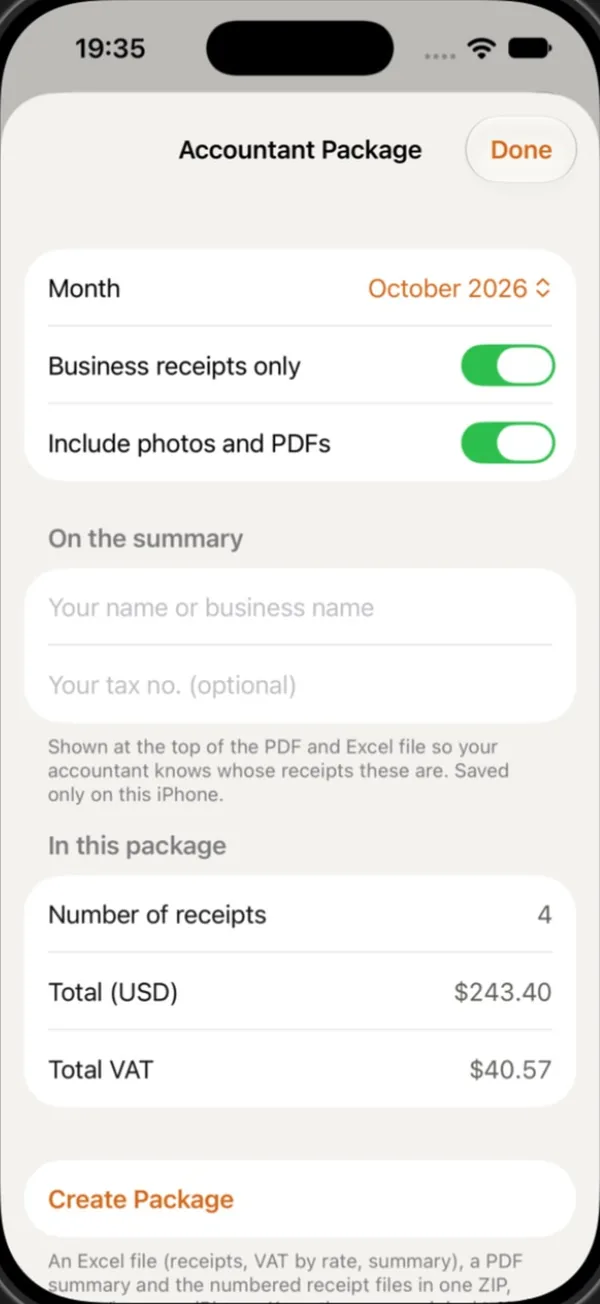
- With Premium, the accountant package builds one ZIP for the month: an Excel workbook with a row for every receipt and its tax lines, a PDF summary, and the original receipt images numbered to match the rows.
- You can include business receipts only, add photos and PDFs, and put your name or business name and tax number on the summary.
Questions
Is a photo of a receipt good enough?
The IRS accepts electronic records that meet the same requirements as paper ones. Keep the image clear and complete, and ask your accountant if you are unsure.
Is a credit card statement enough on its own?
Not always. The IRS notes that a combination of documents may be needed, and the receipt is what shows what you bought.
How often should I send receipts to my accountant?
Monthly works for most people. It is small enough to check and recent enough to remember what each receipt was for.
Sources
- What kind of records should I keep · Internal Revenue Service
- How long should I keep records? · Internal Revenue Service